MSP vs Internal IT Department: What Growing Businesses Should Know Bothell, Washington
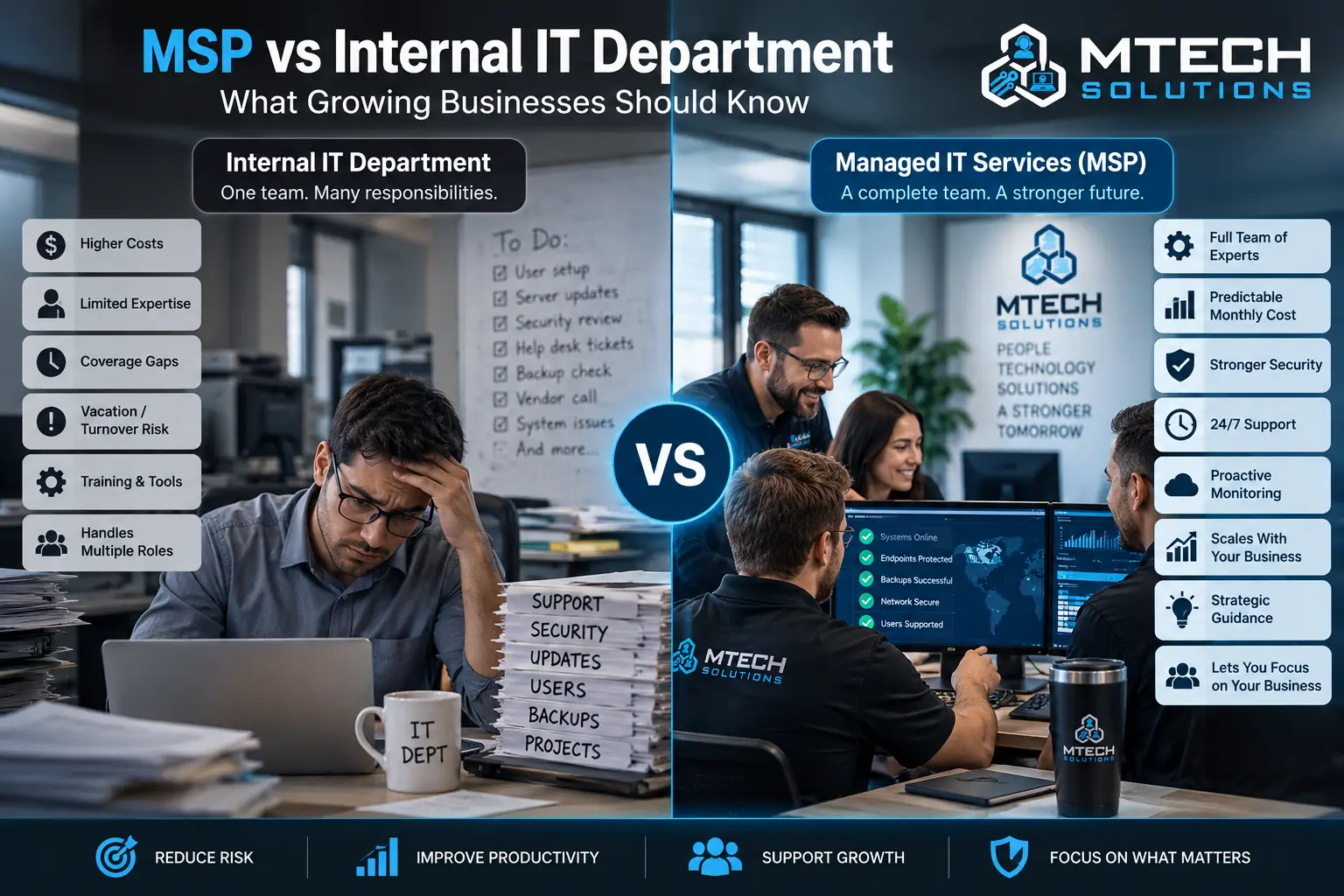
MSP vs Internal IT Department: What Growing Businesses Should Know
As a business grows, technology becomes harder to manage casually.
In the early stages, IT support may be handled by a tech-savvy employee, a break-fix vendor, or whoever knows the most about computers. That may work for a small team, but eventually the business reaches a point where informal IT support creates risk.
Employees need faster help. Cybersecurity becomes more important. Microsoft 365 needs better management. Devices need to be standardized. Backups need to be tested. Leadership needs a clearer plan for technology costs and future growth.
That is usually when business owners start asking an important question:
Should we hire internal IT, work with a managed service provider, or use both?
There is no one-size-fits-all answer. The right choice depends on your company’s size, budget, risk level, industry, and day-to-day technology needs.
The real question is not simply whether an MSP or internal IT is better. The better question is: what does your business need covered every day, and what risks are currently sitting uncovered?
What Is an Internal IT Department?
An internal IT department is made up of employees who work directly for your company and manage technology from inside the organization.
For larger companies, this may include help desk staff, system administrators, network engineers, cybersecurity specialists, cloud administrators, and IT leadership.
For many small and midsize businesses, internal IT usually starts with one person. That person may handle user support, laptop setup, vendor issues, software renewals, cybersecurity tools, printers, phones, cloud accounts, and anything else technology-related.
Internal IT can be valuable because the person or team is embedded in your business. They understand your employees, your office, your workflows, and your daily frustrations.
But internal IT also has limits, especially when one person is expected to cover every technical area.
What Is an MSP?
An MSP, or managed service provider, is an outsourced IT partner that provides ongoing technology support and management for your business.
Instead of hiring every IT role internally, your company gets access to a broader technical team. An MSP can provide help desk support, monitoring, cybersecurity, Microsoft 365 administration, backup management, device support, cloud services, vendor coordination, and strategic planning.
At MTech, managed IT is not just about responding when something breaks. It is about helping businesses create a more reliable, secure, and scalable IT environment.
That includes supporting employees, reducing downtime, improving security, and giving leadership a clearer picture of where technology needs attention.
What Internal IT Does Well
Internal IT can be a strong option when your business needs someone deeply involved in day-to-day operations.
An internal IT employee may understand the personalities, workflows, office layout, and business-specific issues better than an outside provider at first. They can walk over to someone’s desk, help with local equipment, and coordinate closely with leadership.
Internal IT can be especially helpful for:
- On-site support
- Company-specific workflows
- Immediate office coordination
- Internal communication
- User onboarding
- Physical hardware management
- Long-term ownership of internal systems
For businesses with complex internal software or hundreds of employees, internal IT may be necessary.
The challenge is that many businesses do not have enough IT work to justify a full department, but they have too much risk for one person or an informal support model.
Where Internal IT Can Become Overloaded
The biggest issue with a small internal IT team is coverage.
One person may be responsible for everything, including support tickets, cybersecurity, backups, Microsoft 365, network equipment, phones, vendors, software, compliance questions, and technology planning.
That is a lot of responsibility for one role.
Even a strong internal IT person may not have deep expertise in every area. Cybersecurity alone can include endpoint protection, phishing defense, multi-factor authentication, access control, patching, monitoring, incident response, backup strategy, and user training.
Then there is Microsoft 365 security, cloud configuration, device management, vendor coordination, and long-term budgeting.
Internal IT can also create availability challenges. What happens when that person is on vacation, sick, overloaded, or leaves the company? If documentation is limited, the business may be left scrambling.
This does not mean internal IT is a bad choice. It means the business needs to be realistic about what one person or a small team can cover well.
What an MSP Does Well
An MSP gives your business access to a broader team and a more structured support model.
Instead of depending on one person, your company can rely on a provider with experience across multiple areas of IT.
An MSP can help with:
- Employee help desk support
- Device management
- Microsoft 365 administration
- Cybersecurity tools and monitoring
- Email security
- Backup and recovery
- Cloud services
- Network support
- Vendor coordination
- IT documentation
- Strategic planning
For growing businesses, this can be a major advantage.
A good MSP should not only respond to problems. It should help prevent them. That means monitoring systems, applying updates, reviewing security settings, standardizing devices, testing backups, and recommending improvements before small issues become expensive problems.
Cost Comparison: MSP vs Hiring Internal IT
Cost is one of the biggest reasons businesses compare an MSP with internal IT.
Hiring an internal IT employee includes more than salary. The true cost may include benefits, payroll taxes, training, certifications, tools, software, management time, vacation coverage, and recruiting costs.
If your business needs several areas of expertise, the cost increases quickly. A help desk technician, systems administrator, cybersecurity specialist, and IT manager are different roles. One person may not be able to do all of them effectively.
An MSP usually provides service through a monthly agreement. This can make IT costs more predictable and easier to budget.
For many small and midsize businesses, managed IT provides broader coverage than a single internal hire at a more manageable cost.
The right comparison is not just “which option is cheaper?” The better question is: which option gives your business the right level of support, security, and planning for the cost?
Cybersecurity Considerations
Cybersecurity is one of the most important factors in the MSP vs internal IT decision.
Modern businesses face risks from phishing, ransomware, compromised accounts, weak passwords, outdated software, malicious links, and accidental data exposure.
A business with sensitive data needs more than basic computer support.
It needs practical security controls such as:
- Multi-factor authentication
- Endpoint protection
- Email security
- Secure user permissions
- Software patching
- Backup monitoring
- Security awareness training
- Incident response planning
- Microsoft 365 security configuration
If your internal IT person has the time and expertise to manage these areas, that can work. If not, an MSP can help close the gap.
At MTech, cybersecurity is built into managed IT because support and security should work together. A system that is easy to use but poorly protected is not good enough. A system that is secure but impossible for employees to work with is not good enough either.
The goal is practical security that fits the way your business operates.
Support Coverage and Response Times
Another major difference between an MSP and internal IT is coverage.
An internal IT person may be available during business hours, but they can only handle so many issues at once. If multiple employees need help at the same time, support can slow down.
An MSP can provide a broader support structure. Tickets can be prioritized, escalated, and handled by the right technical resource.
This matters for businesses where downtime affects revenue, client service, or operations.
For example, if a law firm cannot access documents, if an accounting team has email issues during tax season, or if a construction project manager cannot open files from the field, support speed matters.
Good IT support should be clear, responsive, and organized. Employees should know how to request help, what to expect, and how urgent issues are handled.
Scalability as Your Business Grows
Growth adds IT complexity.
Every new employee needs a device, email account, software access, security settings, and onboarding support. Every departing employee needs proper offboarding. Every new location, department, or workflow creates additional technology needs.
Without structure, growth creates messy IT environments.
You may end up with inconsistent devices, unclear permissions, duplicate software, unmanaged accounts, and no reliable documentation.
An MSP can help create scalable processes for:
- New employee onboarding
- User offboarding
- Device setup
- Microsoft 365 permissions
- Security policies
- Software licensing
- Cloud storage
- Backup planning
- Vendor management
This helps the business grow without letting technology become disorganized.
When Internal IT Makes Sense
Internal IT may be the right choice if your business has complex daily technical needs that require someone on-site or deeply embedded in operations.
It may make sense if:
- You have a large number of employees
- You need constant hands-on support
- You operate complex internal systems
- You need direct IT leadership inside the company
- You have the budget for multiple IT roles
- You already have strong cybersecurity resources
- Your systems require daily internal coordination
For some companies, hiring internal IT is the right move.
But even then, many businesses still benefit from outside support for cybersecurity, cloud, monitoring, backup, and strategic projects.
When an MSP Makes Sense
An MSP may be the better choice if your business needs professional IT support but does not need or cannot justify a full internal department.
An MSP may make sense if:
- You have recurring IT problems
- Your team needs faster support
- You want predictable IT costs
- You need stronger cybersecurity
- You use Microsoft 365 heavily
- You have remote or hybrid employees
- You are growing and need scalable systems
- You do not have strong IT documentation
- You want strategic guidance without hiring several specialists
For many small and midsize businesses, an MSP provides the right mix of support, security, and planning.
When a Hybrid IT Model Is Best
The choice does not have to be MSP or internal IT. Many businesses benefit from a hybrid model.
In a hybrid model, an internal employee or small IT team handles company-specific needs, while the MSP provides additional support, tools, monitoring, cybersecurity, cloud expertise, and escalation.
This works well when the internal person knows the business but needs more technical depth or backup.
For example, an operations manager may handle basic employee requests but need MTech to manage cybersecurity, Microsoft 365, backups, and larger IT projects. Or an internal IT coordinator may support daily issues while MTech provides strategic planning and advanced technical support.
A hybrid model can give businesses the best of both worlds: internal familiarity with external depth.
Questions to Ask Before Choosing
Before deciding between an MSP and internal IT, ask these questions:
- How many employees need IT support?
- How often do technology issues interrupt work?
- Who is responsible for cybersecurity today?
- Are backups monitored and tested?
- Is Microsoft 365 configured securely?
- Do we have clear IT documentation?
- What happens if our current IT person is unavailable?
- Are technology costs predictable?
- Do we have a plan for growth?
- Are employees getting help quickly enough?
If these questions are difficult to answer, that may be a sign your business needs a more structured IT model.
How MTech Helps
MTech helps growing businesses evaluate, manage, and improve their IT support model.
For some companies, that means fully managed IT services. For others, it means co-managed IT support alongside an internal employee or team. In both cases, the goal is the same: make technology more reliable, secure, and aligned with the business.
MTech can help with support, cybersecurity, Microsoft 365, backup and continuity planning, device management, vendor coordination, and IT strategy.
We focus on practical improvements that reduce risk, support employees, and give leadership a clearer view of technology.
For a full breakdown of what an MSP should cover, read What Is Included in Managed IT Services?
Final Thoughts
Choosing between an MSP and an internal IT department is an important business decision.
Internal IT can provide deep company familiarity and hands-on support. An MSP can provide broader expertise, predictable costs, stronger coverage, and scalable support. A hybrid model can combine both.
The right choice depends on what your business needs now and where it is going next.
If your business is growing, dealing with recurring IT problems, or unsure whether your current support model is enough, MTech can help you evaluate your options.